The circuit was at first designed to transform a SP3T-switch with a NC in the middle to a "regular" SP3T-switch. This might sound kind of useless, but this was cheaper for me then buying new switches since i allready had the parts for this. Also, this gives me the possibility to interface the switches digitaly.
Theory of operation
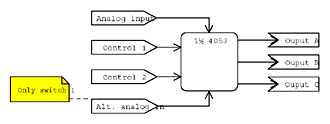
The circuit is based around two CMOS 4053 analog multiplexers, which are setup so that there are three routers avaliable. Each router has one analog input, three analog outputs and two digital control inputs. One of the routers have a special alternative analog input which will be discussed later. Externally, each routers control lines are interpreted as the binary code generetable via a SP3T (NC):
- 00 - output A
- 01 - output B
- 10 - output C
- x0 - output A
- 01 - output B
- 11 - output C
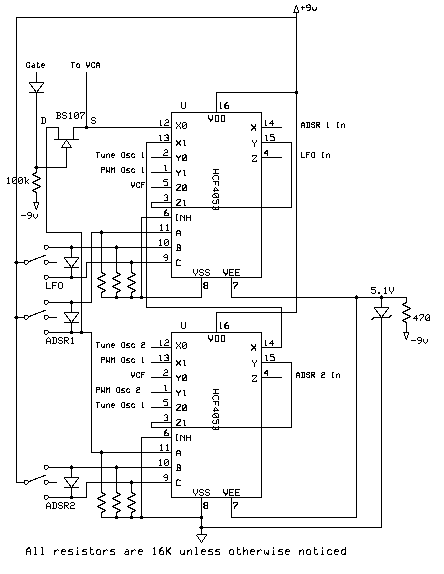
One of the routers has a special feature; a FET switch that makes sure there is allways a signal present at that output. The original intention of this was to have an ADSR that could be routed to three different functions, including a VCA. However when the ADSR was not routed to the VCA, it would be convenient to have a GATE signal routed to it instead, so that there was allways a signal controlling the VCA.
Conclusion
Since this circuit is essentially composed of FETs, it draws
very
little current,
a few µA. On the downside, it has limited voltage swing, the limit for the 4053 is 15v VDD-VEE.
For switching CV signals i have yet to see any problems with it, though it's not suitable for high-end audio
routing. This circuit is small, simple, and replaced my need for buying new switches so i like it!