DIY Modular Synthesizer
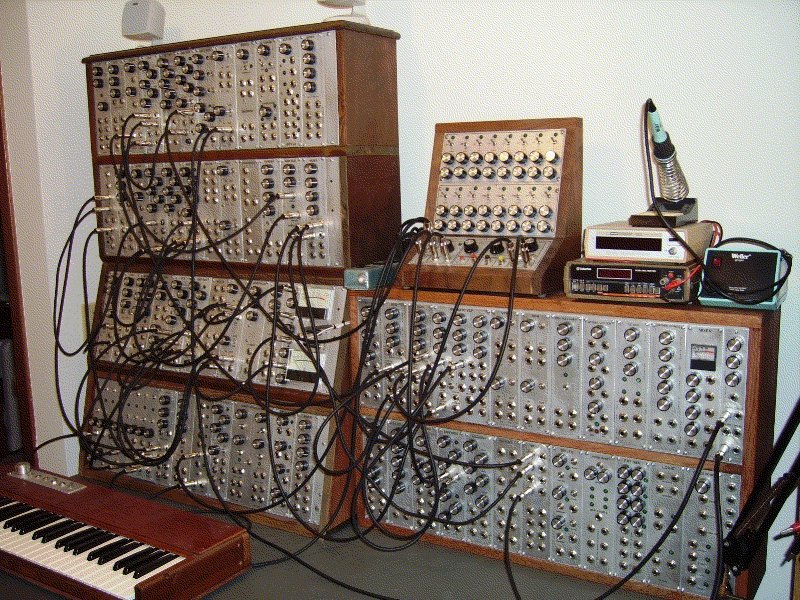
Here's the most recent picture of my Analog Modular Synthesizer as of January 2010.
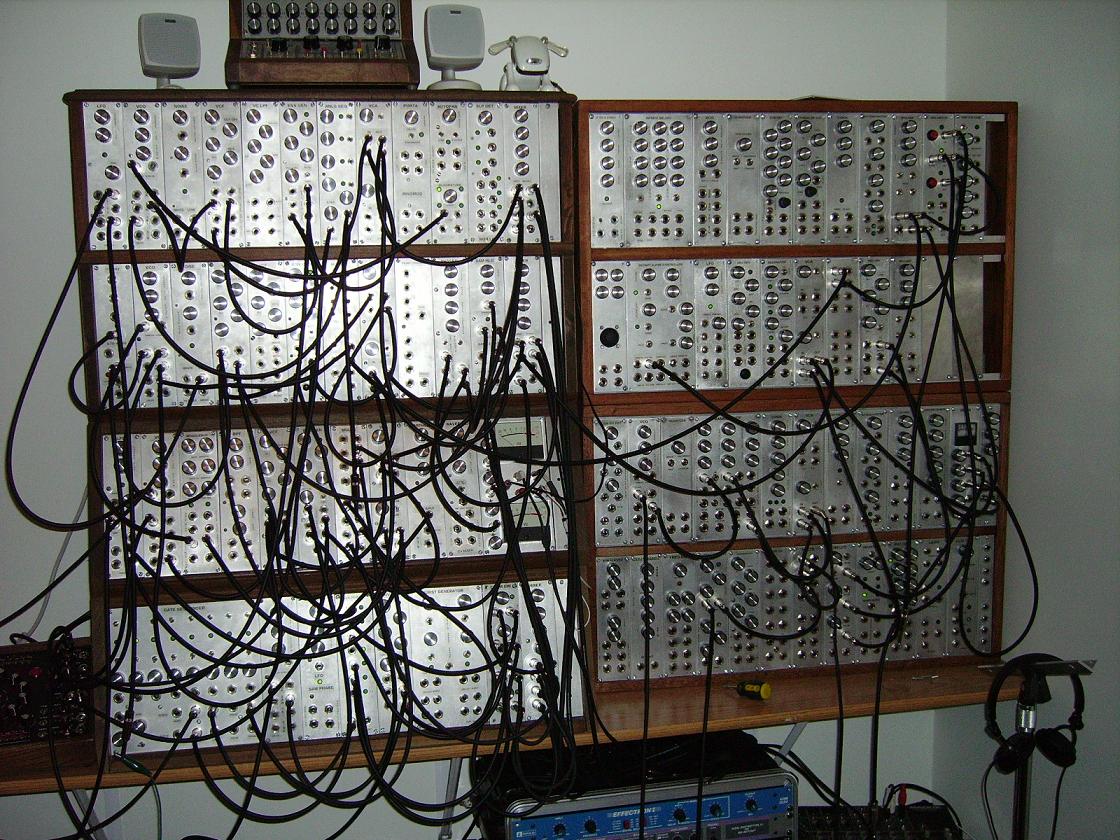
Every module has been built over the past three years.
This is a rough 'Noodle' I recorder recently - It's all hands off - no keyboard, no knob twiddling.
Noodle091808
I just built the upper right hand 2 rows of cab - Just got to catch up with my backlog to fill it.
Here's how I got started building - and a few shots of various projects
I had been looking for a Moog Micro synthesizer for several years. My interest in a synth was primarily to learn about analog synthesis. With my tech background I expected I could find one that needed repair, fix it up and then sell it when I learned what I wanted to learn from it.
I finally found one for a couple hundred dollars on E-bay and purchased it. It was a mess – but some power supply work, changing a few pots, and a good cleaning gave me a useable Moog. It was fun – but I decided it would be great to have a sequencer to use with the Moog.
A Google search for "Analog Sequencer" pointed me to several sites and I stumbled across Ray Wilson’s "Music from Outer Space". Ray’s site provided very nice circuit boards and instructions for building a nice 16 step sequencer, among other projects for building an entire analog modular synthesizer one module at a time.
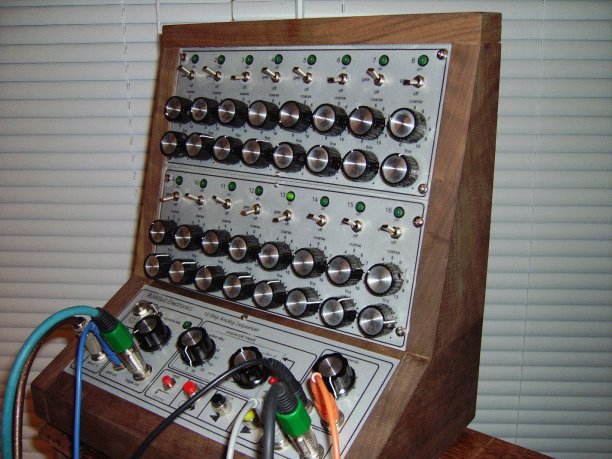
I ordered up the Sequencer boards and parts in late October of 2006 – and began to follow links into the world of SDIY. By the time I had completed the sequencer I had remembered how much I used to enjoy building electronic circuits as a kid. And I wanted to make more.
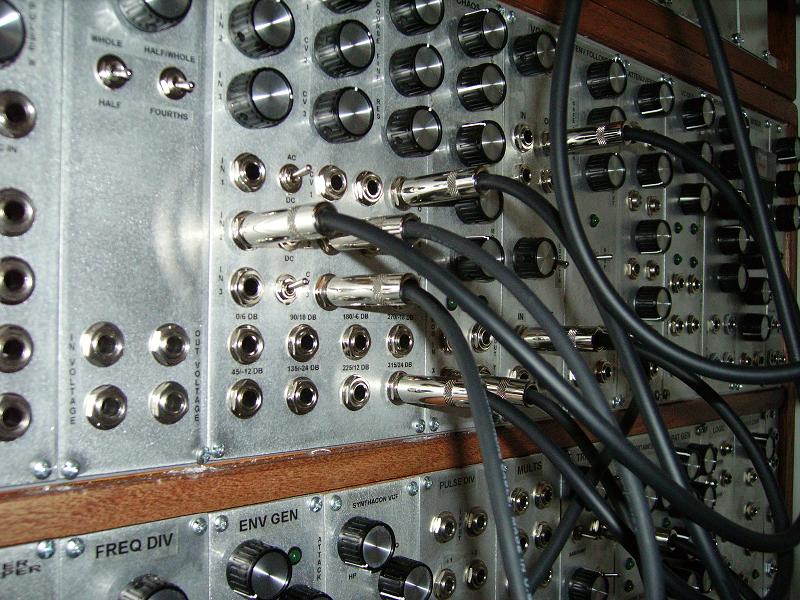
In November of 2006 I ordered a VCO, VCF, VCA, and ADSR PC board from MFOS.
In December 2006 I followed with another VCO, ADSR, LFO, VCF and Noise Cornucopia from MFOS. More boards followed in late December 2006, and I also began to build other circuits I found on the Internet on perfboard.
The winter was spent building, mounting and learning to use the various modules. My initial case was in a four unit high rack with panels for each module – something like a Frac rack. As I continued to build I decided I wanted a more traditional look for the synth, and decided on a Moog Modular format in a wood case. Using wood I had on hand from an old church organ I made a couple racks that would hold 12 of my modules each.
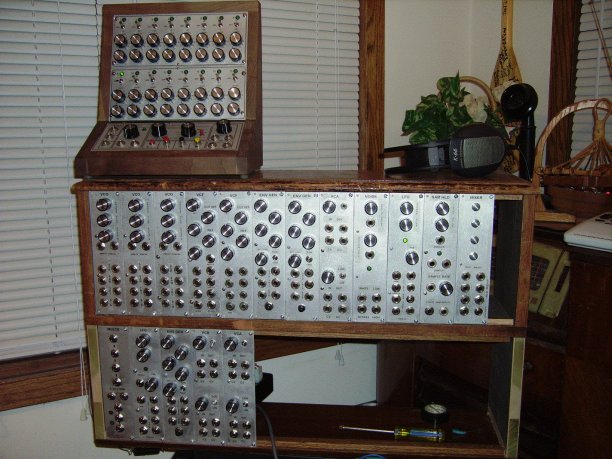
I scrounged some 1/8 inch aluminum from a nearby metal fabricator shop and cut my panels to size using a table saw.
In March of 2007 I found the Electro-Music.com website. This website has an great community of Synth builders and designers - and enough unique circuits and PC board offerings to keep me busy building.
This is the 2 row Cab on the Lower Right.
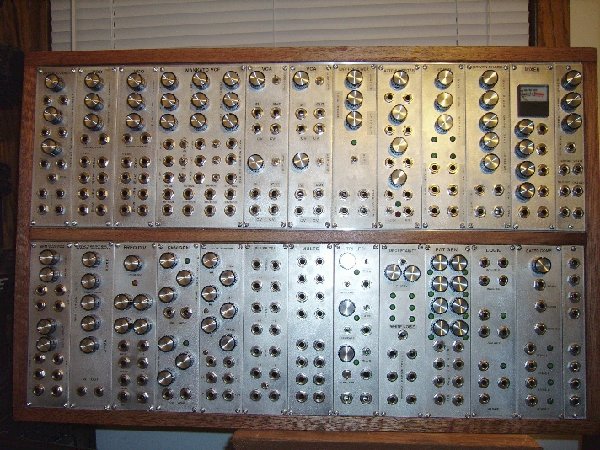
The electronics for this cabinet were built in Winter of 2007-08 with the exception of the Pattern Generator and Synthacon VCF.
The MFOS VCO's & VCA's, Thomas Henry QFQ and Mankato VCF and Fonitronic Attenuverting Mixer were made with purchased PCB's - the rest were built from schematics shared on electro-music and around the web.
Top Row Modules
1in/4 out CV Dist & 3 Passive Attenuators (Normalled to CV Dist), 2 MFOS VCO, Thomas Henry Mankato VCF, 2 MFOS Dual VCA, Polyfusion 2044 copy (Env Follower/Gate Extractor), Fonitronic Attenuverting Mixer, Thomas Henry VC QFG, Ian Fritz Driven Double Well Chaos, 4 in/2 out Mono Mixer, repackaged RatShack Reverb.
Bottom Row
EFM VCO-VCA, Grant Richter CV Twister-Wave Warper, Blacet Freq Divider copy, Ian Fritz Dual AD/AR Gen, Synthacon VCF copy, 3 Pulse Dividers, 4*4 Mults, 3 MFOS Simple LFO, Synth X Random Gate/Uncertainty Module copy, Dual Bugbrand Pattern Gen with Triggers, AND/OR/Inverter Logic, CGS Gated Comparitor, 2 *4 Mults
The module panels are 8.5 by 2.25 inches by 1/8 inch aluminum. Labeling is clear Dymo.
Mahogany probably isn't the best choice for durability - it gets 'dinged' pretty easy - but it's easy to work with, inexpensive and I like the look. Two 4 foot by 7 inch by 1 inch pieces of mahogany were used for the frame, and a 1 inch by 3 inch piece for the center divider.
RF's Synth Module by Module June 2008. Cab 1 MFOS LFO | | MFOS VCO | | MFOS Noise | | MFOS 24 dB VCF | | Fonitronic VCF |
| MFOS EnvGen | | 4017
Sequencer | | MFOS VCA | |
MFOS
Portamento/RingMod | | MFOS
AutoPan/ TH QFG | | CGS Slope Det
| | Mixer Cab 2 MFOS CV Dist | | MFOS VCO | | MFOS Noise | | MFOS 24dB VCF | | MFOS 12 dB VCF | | MFOS Env Gen | | Mults | | MFOS VCA | | Serge Peak Trough
| | MFOS
Phaser | | MFOS Samp-Hold |
| Mixer Cab 3 MFOS LFO | | MFOS VCO | | Wogglebug#3 | | CGS BPF | | MFOS 24 dB VCF | | MFOS Env Gen | | Mults | | MFOS VCA | | Morph-Lag | |
Wavfolder-CV Mixer | |
Mixer Cab 4 CGS Gate Sequencer | | MFOS VCO | | CGS
Psycho LFO/Sawtooth Phase | | CGS
Pulse Divider | | MFOS Env
Gen | | CGS Burst Gen | | CGS Drum Sim | | Mixer Cab 5 CV Dist-Passive Atten | | MFOS VCO | | MFOS VCO | | TH Mankato VCF | | MFOS VCA | | MFOS VCA | | Env Follower | |
Fonitronic Attvert Mixer | | TH VC QFG | |
Ian Fritz Chaos | | Mixer |
| Reverb Cab 6 EFM VCO-VCA | | CV Twister-Wave
Warper | | Freq Divider | | Ian
Fritz Env Gen | | Synthacon VCF | | Pulse Divider | | Mults | | Tri LFO | |
Uncertainty | | Bugbrand
Pattern Gen | | CGS Logic | | Gated
Comparitor | | Mults Cab 7 Frequency to Voltage Conv. | | CGS Infinite Melody Generator || MFOS VCO || MFOS Quantizer || CGS Sub-Oscillator
||Ian Fritz Threeler VCF | | Fritz Chaos || Fonitronic Attenuvertor || Blank (pending backlog) || Blank || Blank
Cab 8 Joystick CV Controller || Thomas Henry SN Super Controller | | MFOS LFO | | MFOS ADSR | | Fonitronic PS-3100
Resonator | | MFOS Dual VCA | | Mults | | Resonant Low Pass Gate | | Blank | | Blank | | Blank
2 VC LFO ( MFOS /Ray Wilson
PCB) Simultaneous Sine, Triangle, Saw,
Ramp, and Variable Pulse Width Rectangle Outputs. Voltage Control of Frequency
(approximate log response, NOT 1V/Octave) Voltage Control of Rectangle Pulse
Width Fine and Coarse Frequency Control
Very Low Frequency (1 Cycle per
several minutes) 6 VCO ( MFOS /Ray Wilson
PCB) Simultaneous Rectangle, Sawtooth,
Triangle and Sine Outputs (Saw core design) Designed for 1V/Octave control
voltage 3 1V/Octave control voltage inputs.
1 Linear control voltage input.
Hard sync input. Rectangle wave duty cycle adjustable
between 10% and 90% Rectangle wave duty cycle voltage
controllable 1 16 Step Sequencer ( MFOS /Ray Wilson
PCB) Produces sequences of 4 to 16 steps
in length Modes include stop at count, reverse
at count, reset at count and random 16 mode Each step has coarse tune, fine
tune, and switchable gate Accepts external clock and external
start pulse. Simultaneous outputs with and
without portamento. Forward, Back, and Reset
controls. 3 24 DB VCF ( MFOS /Ray Wilson
PCB) Four Pole 24dB Per Octave Low Pass
Filter Log Response to Control Voltage
(1V/Oct Tunable) Makes A Nice Sine Wave Oscillator
Voltage Controlled Cut-Off Frequency
Voltage Controlled
Resonance 1 12 DB State Variable VC
Filter ( MFOS /Ray Wilson
PCB) State Variable VCF 12dB/Octave With
VC Resonance Simultaneous High-Pass, Low-Pass and
Band Pass Filter outputs. Log Response to Control Voltage
(1V/Oct Tunable) Sine Wave Oscillator at full
resonance Voltage Controlled Resonance (Linear
control) 5 Dual VCA ( MFOS /Ray Wilson
PCB) Log and Linear Response to Control
Voltage DC Coupling Throughout 1 Autopan ( MFOS /Ray Wilson
PCB) Leslie Spin-up/Spin-down
Simulator Mimics the Rhodes Stage Piano stereo
tremolo CV Control of Panning
Rate. (On same panel is the
QFG) 1 Thomas Henry QFG
(Perfboard) The Quadrature Function Generator
produces 4 simultanious sine wave voltage outputs 90 degrees out of phase. 1 VC Phaser ( MFOS /Ray Wilson
PCB) Switchable 4 or 8 stage phase
shifter. Variable feedback ranges from mild
swooshing to raucous mind bending. Two external control voltage inputs.
Pseudo stereo output when 4 stage
and 8 stage outputs are used. On-Board LFO produces Triangle and
Ramp waves. Phase angle is modulated in a
logarithmic fashion. 8 Stages of phase shift result in a
barber pole effect. 1 Sample and Hold ( MFOS /Ray Wilson
PCB) Sample Rates from .05HZ to 1KHZ.
Voltage Controlled Sample Clock
Clock Sync-In Can Double As External
Clock In Glide Control To Slew Between
Samples. 4 Envelope Generator ( MFOS /Ray Wilson
PCB) 1 mS to 20 second Attack, Decay, and
Release times. Classic ADSR envelope shape and
functionality. Gate and trigger inputs permit
retrigger after Attack complete. Comparators on gate and trigger
inputs. 2 Noise Cornucopia ( MFOS /Ray Wilson
PCB) White Noise. Pink-ish Noise High Pass Noise Adjustable Grainy Noise. Adjustable Random Gates. 1 Foniktron SSM2044 VCF
PCB A Voltage Controlled Low Pass Filter
Based on the SSM2044 Chip. 1 4 Step Analog Sequencer
(Perfboard) Simple 4 step sequencer based on the
CD4017 decade counter chip. It uses a 555 based Clock and CGS Trigger to Gate converter. 1 Aaron CRAM Portamento /
RingMod (Perfboard) Portamento is the 'glide' from one
note to another. This module can be used as an LFO
with the toggle switch in that position The Ring Modulator takes two signal
inputs and outputs a sum and difference of them. Often used to provide 'clangorous' sounds such
as bells. 1 CGS Slope Detector / Dave Magnuson NOR Logic Gates
(Perfboard) The slope detector is an
event-driven gate/trigger generating device. It monitors a control voltage, and responds
according to what that voltage is doing. If the voltage is rising,
the slope detector gives a "gate" output (approx. 5V) on its "rising" output. Likewise, if the
voltage is falling, the slope detector gives an output on its "falling" output. The
duration of this gate signal depends on the incoming CV and the setting of the sensitivity pot.
When the CV is remaining constant, the "steady" output activates. These gate signals can be used to
fire envelope generators dependent on the action of the CV, for example opening a filter when a
melody is rising in pitch, and closing it
when the melody is falling in pitch. It can also be used to generate gate signals from LFOs,
envelope generators, to advance sequencers etc. The sensitivity pot allows the slope
detector to work with either relatively fast events, like the edges of a square wave pulse
train, or very slow events, such as the sine output
of an LFO being used to drive filter/phaser sweeps. 3 4 Input Mono Mixer
(Perfboard) Basic 4 input mono mixer based on a
TL084 Op Amp. 4 Summed outputs. 1 4 Input Dual Mono Mixer
with VU Meters (Perfboard) 4 input Dual mono mixer with 2
outputs per channel, plus Stereo Headphone jack. 3 4*4
Mults Four sets of Four 1/4 inch Jacks
summed together for splitting control votages or audio signals to different locations 1 S to V trig Converter /
Mults Converts Moog "S" trigger to "V"
trigger for triggering events from the Micromoog. Mults split CV from Moog to VCO's 1 Serge Peak/Trough
(Perfboard) This has two sections, each with
four inputs and one output. The peak section would output the highest of the four inputs, while
the trough section would output the lowest of
the four inputs. The peak section was often used for combining gates from a sequencer, but
either section could used to combine waveforms, CVs or envelopes in unexpected
ways. 1 Wogglebug #3
PCB The "WoggleBug" is a random voltage
generator. It is a continuation of "smooth" and "stepped" fluctuating random voltage sources
pioneered by Don Buchla. The core of the
circuit is based on the Buchla Model 265 "Source of Uncertainty" module. 1 CGS BPF (Dual) (Perfboard) A utility bandpass filter for
creating artifical instrument resonant cavities etc. 1 Harry Bissell Morphlag
(Perfboard) A Lag circuit with independent
ATTACK and DECAY controls and a SHAPE control to vary the response from linear to
log. 1 CGS Wavefiolder / CV Mixer (Perfboard) The Simple Wave Folder - The effect
it produces is not like unlike that of the Serge middle wave multiplier - harmonically rich
waveforms that can be swept for filter-like
effects. It MUST be fed a triangle or sine wave to function properly. 1 CGS Psycho LFO / Magnus Danielson Sawtooth Doubler and Phase
(Perfboard) This is a bizarre little LFO that
produces a wide range of pseudo random effects. The Sawtooth Doubler and Sawtooth
Phase are included on the module. 1 CGS Gate Sequencer with CV (Perfboard) An 8-step sequencer designed for
controlling pulsed or gated events, for rhythm and percussion. The CV Adapter convers it to a
traditional eight-step control voltage sequencer. 1 CGS Pulse/Clock Divider (Perfboard) This module consists of several
parts, a pulse divider with integer divisions between 2 and 8, and several logic elements. The
divider is used to generate interrelated pulses for
use in creating poly-rhythms, and unusual sequences. It can also be run at audio frequencies as
a sub-oscillator/sub harmonic generator. The output pulse from each division
is one clock cycle in length, and the relationship between pulses is fixed. Specifically, the /4
output will correspond to every second pulse from the /2 output. Likewise, the /8
will correspond to every second pulse from the /4 output, and the /6 will correspond to every
second pulse from the /3 output. Needless to say, the /2 and /3 groups are not
related to each other, or to the /5 or /7 outputs. All however share a common external reset, so
they can be synchronized. All outputs go high on reset. Some ideas on how to use this
module: Feed a clock signal into the input
of the pulse divider. The divided signal is available simultaneously for each output. If running
at audio frequencies, feed some of these to a
mixer or other signal processing device. If running at low speed, try driving two different
sequencers at the same time from different divisions. Try feeding the /8 output into the
reset - this will force all to synchronize to a /7 count, with the lesser divisions becoming
"syncopated". An AND gate could be used to control
a clock signal. If the second input is LOW, no clock signal passes. If the second input is high,
the signal passes unimpeded. Of course,
there are a lot more things that can be done with the logic gates. For example, the /6 and /7
outputs could be ANDed together, and that would give a pulse every 6 x 7 (42)
clock pulses (i.e. 1 pulse immediately the pulse divider is reset, and the second 42 pulses
after that etc.). 1 CGS Burst Generator (Dual)
(Perfboard) This module is a rhythm and timing
accessory. It generates a burst of gate or trigger pulses at various speeds as set from a front
panel control. At higher speeds it can be used for
washboard, maracas or similar rapid-burst percussive effects when connected to the appropriate
sound generating device such as a ringing
oscillator. At lower speeds it can be used to
step a sequencer a certain number of steps or retrigger an envelope shaper. The output pulses
are quite narrow when the specified
component values are used, and would best be described as trigger pulses in synths that
distinguish gates from triggers. Increasing some component values will give longer
gate like pulses. 1 CGS Drum Simulator (Dual)
(Perfboard) This module is the embodiment of the
classic twin-T circuit in a form that is suitable for connection to modular synthesizers. It
contains 4 separate drum sounds, each
individually triggered, as well as adjustable harmonic content. 1 Grant Richter CV
Twister/Wave Warper (Perfboard) This is a circuit adapted from the
Sandin Image Processor. The original circuit was used to give "solarized" effects to video
signals. The basic idea is to use diodes to
split the input voltage into three sections - plus, minus and "near zero". Each section is then
run to a scalable follow/invert circuit. Since the
breakpoints are fixed by the diode voltage drop, an input "span" control allows adjustment of
the breakpoint relative to the input voltage range. The output "Gain" control then
allows boosting the signal back up to the 10 volt range. 1 CGS Synthacon/Steiner VCF
(Perfboard) This module is a "tribute" module,
based on the Steiner-Parker Synthacon VCF. Unlike the original, this version
allows signals to be fed into all inputs simultaneously. If the same signal is used in all
inputs, the result is reminiscent of a phaser. The real fun
starts when you feed different signals into each input, then you get a frequency based
"interpolating scanner", where panning between different sound sources is possible,
though also subject to the frequency at which they are running. Each of the filter type inputs has
its own level control. The ALL input is also affected by these level pots as it mixed with the
individual inputs prior to the level controls. If using only a single input, it may
be better to feed the signal into the ALL input, and adjust the level pots to select LP, BP or
HP, rather than changing the patch cord between
the specific input jacks. 1 CGS Boolean Logic Gates
(Perfboard) Four boolean logic elements, two
inverters an OR gate and an AND gate for the processing of gate and trigger signals. 1 Synth X Ensign Random
Gate Generator - Uncertainty Module (Perfboard) Dual 555 Timer based random Gate
generators - Includes White Noise Generator Output 1 BugBrand Pattern Generator
(Perfboard) Dual 4 step pattern generator with
CV outputs. Input two clocks to a side and complex patterns are formed based on the binary
relationship of the clocks at any point in time.
Produces a Trigger output at each change. 1 CGS Gated Comparitor
(Perfboard) This module takes a Clock source and
a Signal source as inputs and creates 4 gate outputs in a pattern. 1 Blacet Frequency Divider
(copy) (Perfboard) The Frequency Divider converts a
monophonic analog signal applied to the "IN" jack into digital pulses which are divided by two
sections of CMOS digital counters. One
section, controlled by the 4 pots mix divisions 1, 1.5, 2, and 3 together to form complex sub
octave waveforms. The output signal is present at the lower "OUT" jack. The second counter section,
controlled by the rotary switch on the top of the module, divides the input signal by 6 thru 10.
For example, a 440 Hz signal divided by 10 would
result in a 44 Hz signal at the two "Pulse Out" jacks. 1 Polyfusion 2044 Copy -
Envelope Follower/Gate Extractor (EFG) (Perfboard) An envelope follower takes an audio
input and converts it into a control voltage. This control voltage will rise and fall with the
overall volume of the input signal. The louder the
input, the bigger the output of envelope follower. The EFG has1 CV outputs available Switchable
between Fast, Medium and Slow. The Fast is useful for tracking fast moving
cymbal and hi-hat patterns. The slower one is more useful in processing single instruments. By
using the CV output to control VCAs and VCFs it is very easy to create
synchronised patterns that keep in perfect time with a drum machine or other musical input.
Another feature of the EFG, is the
provision of a gate extractor. This part analyses the peaks in the music and creates a gate type
signal in time with these peaks. This can be
used to trigger envelope generators in time with an external drum loop or click track. A Gate
Threshold rotory control enablesyou to get clean gate signals from all sorts of input
material. 1 EFM VCO/VCA Combination
module (Perfboard) This OTA core VCO is based on the
National Semiconductor application notes. It has one one-volt per octive input, sync and three
control voltage inputs for modulation. Featuring native triangle and square
outputs. The sine output is derived from the tri using a system 100 style tri to sine
converter. There is a classic OTA VCA also on
this board just because it's always nice to have lots of VCAs around. 1 Ian Fritz Design Dual AD/AR Envelope
Generators (Perfboard) 1 Ray Wilson Design Triple
Ramp/Sine/Sawtooth LFO's (Perfboard) 1 Triple Pulse/Octave
Divider (Unknown Designer) (Perfboard) Provides 1 and 2 octave down
division of Audio or Pulse signals 1 4 Input Mono Mixer with VU
Meters (Perfboard) 4 input mono mixer with 2 outputs.
1 Keyboard 1v/Octave CV
Controller ( MFOS /Ray Wilson
PCB) 1 Thomas Henry 'Mankato' VCF
PCB 1 Fonik Attenuverting Mixer
PCB 1 Thomas Henry VC QFG PCB
(Voltage Controlled Quadrature Function Generator) 1 Ian Fritz Design Driven Double Well
Chaos (Perfboard) 1 Passive Attenuator / CV
Distributer (Perfboard) 1 Stereo
Reverb Repackaged Radio Shack